

Data has become an important part of business decision-making. Companies across industries collect information from websites, applications, customer transactions, marketing campaigns, financial systems and connected devices. However, raw data is not always ready for analysis. It needs to be collected, organised, processed and delivered in a reliable format.
This is where Data Engineering plays an important role. Data engineers build and maintain the systems that help organisations move data from different sources into databases, data warehouses and analytics platforms. These systems support reporting, business intelligence, artificial intelligence and machine learning applications.
For students and professionals interested in building a career in this field, choosing the right training programme is an important step. A well-structured Data Engineering course in Pune can help learners develop technical foundations, understand industry tools and practise building data pipelines.
What Is Data Engineering?
Data Engineering is the process of designing, developing and maintaining systems that collect, transform, store and deliver data. The goal is to make accurate, organised and accessible information available to analysts, data scientists, software teams and business stakeholders.
For example, an online shopping company may receive thousands of orders every day. A data engineer can build a pipeline that collects order records, removes invalid entries, combines information from multiple databases and loads the processed data into a warehouse. Business teams can then use that information to study sales, customer behaviour and inventory requirements.
What Does a Data Engineer Do?
- Collect data from databases, APIs, applications and external sources.
- Build ETL and ELT pipelines to move and transform information.
- Clean, validate and organise data for reliable analysis.
- Develop and optimise SQL queries and database structures.
- Process large datasets using distributed computing technologies.
- Work with cloud storage, data warehouses and analytics platforms.
- Schedule, monitor and troubleshoot automated data workflows.
- Maintain data quality, security and processing reliability.
Why Choose a Data Engineering Course in Pune?
Pune has an established technology and IT services ecosystem, with companies working in software development, cloud computing, analytics, consulting and enterprise technology. Learning Data Engineering can help students prepare for opportunities in these areas, depending on their skills, project experience and interview performance.
When comparing Data Engineering classes in Pune, learners should look beyond the course title. A useful programme should cover fundamental concepts, practical exercises, real-world scenarios and the tools commonly used to build modern data systems.
Strong Technical Foundation
Develop an understanding of databases, SQL, Python, data structures and data processing fundamentals before moving to advanced tools.
Practical Learning
Apply concepts through exercises involving data cleaning, database queries, transformations and automated pipelines.
Modern Data Technologies
Explore Spark, PySpark, workflow orchestration, cloud platforms and data warehouse technologies.
Career Preparation
Build project experience, practise technical interviews and prepare a resume that demonstrates your data engineering skills.
Essential Skills to Learn in Data Engineering
A successful learning journey starts with the fundamentals and gradually progresses to large-scale processing and cloud-based data systems. The following skills form a useful foundation for aspiring data engineers.
1. SQL and Database Management
Structured Query Language (SQL) is one of the most important skills in Data Engineering. It is used to retrieve, filter, combine, update and analyse information stored in relational databases.
Important topics include:
- SELECT statements, filtering, sorting and aggregation.
- INNER JOIN, LEFT JOIN and other join operations.
- Subqueries, Common Table Expressions and window functions.
- Primary keys, foreign keys and database normalisation.
- Indexes, query optimisation and performance tuning.
- Fact tables, dimension tables and data warehouse modelling.
Beginners can practise these concepts using MySQL or PostgreSQL. Strong SQL knowledge also helps learners understand how data is structured before it enters a processing pipeline.
2. Python Programming
Python is widely used to automate data processing tasks and build data pipelines. It helps engineers connect to APIs, process files, validate records and integrate different systems.
Learners should understand variables, loops, functions, collections, modules, exception handling, file operations and working with external libraries. Familiarity with Pandas and JSON processing can also be useful.
3. ETL and ELT Pipelines
ETL stands for Extract, Transform and Load. Data is extracted from one or more sources, transformed into the required structure and loaded into a target system.
ELT stands for Extract, Load and Transform. In this approach, data is loaded into a destination platform before transformations are performed within that platform.
Understanding both approaches helps learners design workflows for reporting, analytics and business applications. Practical exercises can include importing CSV files, validating records, handling duplicate data and loading cleaned information into a database.
4. Big Data and Distributed Processing
Traditional processing methods may become inefficient when datasets grow substantially. Big Data technologies support the storage and processing of large volumes of information across distributed systems.
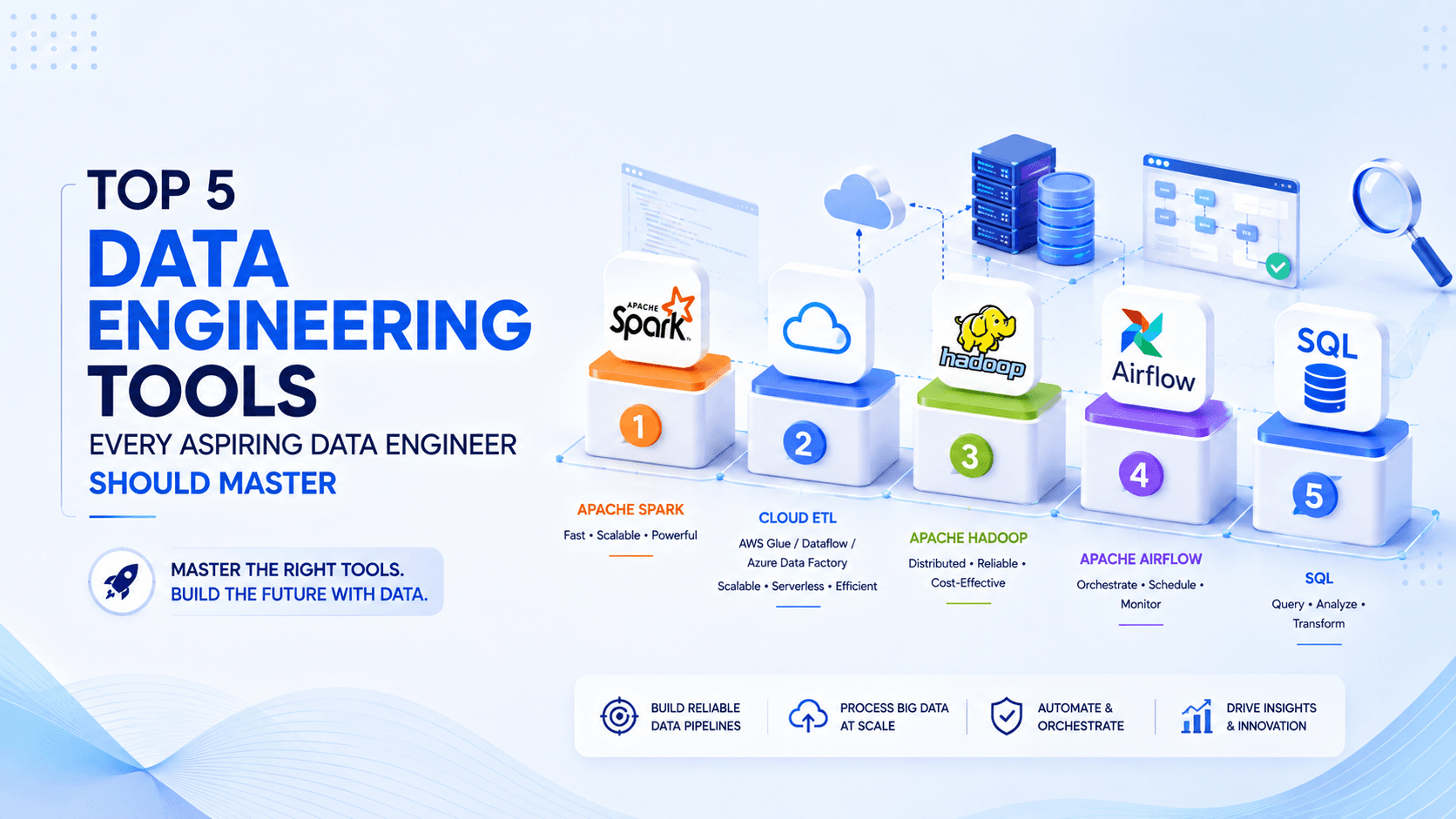
Learners can explore Apache Spark and PySpark to understand distributed data processing, transformations, joins, partitioning and large-scale data operations. Hadoop concepts can provide additional background on distributed storage and processing.
5. Cloud Computing and Data Warehousing
Modern data platforms often use cloud services to store data, run processing jobs and support analytics. Data engineers should understand the basic concepts of cloud storage, compute resources, permissions, data integration and cost management.
Depending on the learning programme and career goals, learners may explore Amazon Web Services (AWS), Microsoft Azure and Google Cloud Platform (GCP). Data warehouse and lakehouse technologies such as Snowflake, BigQuery and Databricks are also useful areas to investigate.
6. Workflow Automation and Orchestration
Data pipelines often contain several dependent tasks. Apache Airflow helps schedule, organise and monitor workflows using directed acyclic graphs, commonly called DAGs.
Learning orchestration concepts helps engineers manage task dependencies, retries, schedules, failures and monitoring. These skills are important when moving from simple scripts to more dependable data workflows.
Popular Data Engineering Tools and Technologies
The tools required for a Data Engineering role depend on the organisation, its architecture and the scale of its data systems. The following technologies provide a useful overview of the modern data ecosystem.
| Technology | Primary Purpose | What Learners Should Understand |
|---|---|---|
| SQL and MySQL | Querying and managing relational data | Joins, subqueries, database design and optimisation |
| Python | Automation and data processing | Functions, libraries, file handling and error handling |
| Apache Spark | Distributed data processing | Transformations, execution concepts and performance |
| PySpark | Using Python with Apache Spark | DataFrames, joins, transformations and partitioning |
| Apache Airflow | Workflow scheduling and orchestration | DAGs, dependencies, retries and task monitoring |
| Databricks | Data engineering and lakehouse workflows | Notebooks, Spark processing and data storage concepts |
| AWS, Azure and GCP | Cloud infrastructure and data services | Storage, compute, access control and data integration |
| Snowflake and BigQuery | Cloud data warehousing | Loading, querying and organising analytical data |
Beginners do not need to master every technology at once. A practical learning sequence is to build strong SQL and Python foundations, learn ETL concepts, practise Spark and PySpark, and then develop experience with a cloud platform and workflow orchestration.
What Will You Learn in the JVM Institute Data Engineering Course?
JVM Institute offers a Data Engineering training programme in Pune covering core programming, database technologies, big data processing and cloud-based data engineering concepts. The published programme describes a six-month learning track with online and offline learning options.
The curriculum is designed to help learners progress from foundational concepts towards practical data engineering workflows. You can explore the official JVM Institute Data Engineering course syllabus for the latest module details.
Database and SQL
Learn relational database concepts, SQL queries, data modelling, joins, analytical functions and query optimisation.
Python Programming
Develop programming fundamentals for data manipulation, automation and pipeline development.
Big Data and PySpark
Understand distributed processing and work with larger datasets using Spark-based technologies.
Cloud and Data Platforms
Explore cloud data services, data warehousing, workflow orchestration and modern data processing environments.
Practical Projects and Hands-On Learning
Practical experience is an important part of preparing for a technical role. Learners should aim to build projects that demonstrate how data moves from a source to a useful destination.
Example projects to practise during a Data Engineering learning journey include:
- E-commerce data pipeline: Collect order and product records, clean the data and create sales reporting tables.
- Customer analytics pipeline: Combine customer, transaction and marketing data for business analysis.
- Cloud data warehouse: Load structured datasets into a cloud platform and prepare them for analytical queries.
- Automated ETL workflow: Schedule data extraction, transformation, validation and loading tasks.
When evaluating any Data Engineering institute in Pune, ask how many projects you will complete, which tools you will use directly, whether you will write and debug your own code, and how your work will be evaluated.
Career Opportunities After a Data Engineering Course
Data Engineering skills can support several career paths in the technology industry. The role you qualify for will depend on your programming ability, understanding of databases, project portfolio and practical experience.
1. Junior Data Engineer
Junior data engineers help develop, test and maintain data pipelines. Typical responsibilities may include writing SQL queries, cleaning datasets, fixing processing errors and supporting senior engineers.
2. ETL Developer
ETL developers build workflows that extract information from source systems, transform it according to business rules and load it into databases or data warehouses.
3. Big Data Engineer
Big Data Engineers work with technologies that process large datasets across distributed systems. Depending on the role, relevant skills may include Spark, PySpark, Hadoop and cloud data platforms.
4. Cloud Data Engineer
Cloud Data Engineers build and maintain data solutions on platforms such as AWS, Azure or Google Cloud. They may work with cloud storage, processing services, data integration and warehouse solutions.
5. Data Platform Engineer
Data Platform Engineers help maintain the infrastructure and services that data teams use. Their work may involve platform reliability, automation, monitoring, access management and deployment processes.
6. Analytics Engineer
Analytics Engineers focus on transforming raw data into reliable, well-structured datasets for reporting and decision-making. SQL, data modelling and testing are particularly useful in this role.
Data Engineering Career Scope and Salary Factors
Data Engineering opportunities exist in areas such as IT services, financial technology, e-commerce, healthcare technology, logistics, consulting and cloud-based software businesses. Organisations need dependable data systems to support analytics and increasingly complex applications.
Salaries vary considerably by location, employer, technical expertise, years of experience and interview performance. There is no single salary that every graduate of a Data Engineering course can expect.
When researching compensation, compare current job listings for junior data engineers, ETL developers and cloud data engineers in Pune. Review the required experience, technologies and responsibilities rather than relying on advertised maximum packages alone.
Developing practical skills in advanced SQL, Python, PySpark, cloud services, data modelling and pipeline troubleshooting can strengthen your profile over time.
Who Should Join Data Engineering Training?
A structured Data Engineering programme may be suitable for learners who want to build a technical career and are willing to practise programming and problem-solving consistently.
- Fresh graduates exploring careers in data and cloud technologies.
- IT professionals looking to specialise in data engineering.
- Software developers interested in data platforms and pipelines.
- Data analysts who want to develop stronger engineering skills.
- Career changers who are prepared to learn programming fundamentals.
Beginners should be comfortable learning logical thinking, writing code and debugging errors. You do not necessarily need to know every tool before enrolling, but you should be ready to practise regularly and complete assignments independently.
How to Choose the Best Data Engineering Institute in Pune
The best course for you is one that matches your current level, career goals, schedule and budget. Before enrolling, compare the following factors.
- Curriculum: Confirm that the syllabus covers SQL, Python, ETL, Spark, cloud platforms and relevant data engineering concepts.
- Practical training: Ask whether you will complete guided labs and independent projects using the actual tools.
- Trainer expertise: Understand the instructors' technical backgrounds and teaching approach.
- Learning support: Check how doubts, assignments and missed classes are handled.
- Career assistance: Ask what resume support, mock interviews and placement assistance include.
- Fees and schedule: Compare total fees, class timings, lab access and any additional charges.
- Alumni outcomes: Request verifiable examples of relevant student projects and job outcomes.
JVM Institute provides a Data Engineering programme in Pune with online and offline learning options, technical training and career preparation support. Review the current syllabus and speak with the admissions team to confirm the batch schedule, course fees, practical lab access and the precise terms of placement assistance.
Frequently Asked Questions About Data Engineering Courses in Pune
1. Which is the best Data Engineering course in Pune?
The best course depends on your goals, learning style and budget. Compare curriculum depth, hands-on projects, trainer expertise, cloud lab access and career support. JVM Institute is one option to explore for structured Data Engineering training in Pune.
2. Can beginners learn Data Engineering?
Yes. Beginners can start with SQL, database fundamentals and Python, then progress to ETL pipelines, Spark and cloud technologies. Consistent coding practice is essential.
3. How long does a Data Engineering course take?
Course duration depends on the syllabus and learning format. JVM Institute lists a six-month Data Engineering programme. Confirm the latest batch schedule directly with the institute.
4. Which tools are important for a Data Engineer?
SQL and Python are important foundations. Apache Spark, PySpark, Airflow, cloud platforms, data warehouses and data modelling are also useful, depending on the target role.
5. Is Python necessary for Data Engineering?
Python is widely used for pipeline development, automation and data processing. Some roles focus heavily on SQL or particular data platforms, but learning Python expands your options.
6. What jobs can I apply for after Data Engineering training?
Depending on your skills and experience, possible roles include junior data engineer, ETL developer, data platform engineer, cloud data engineer and analytics engineer.
7. Does JVM Institute provide placement assistance?
JVM Institute advertises placement support and interview preparation. Contact the institute to understand the current services, eligibility criteria, hiring opportunities and applicable terms.
8. What should I check before enrolling?
Review the full syllabus, course fees, teaching format, lab access, projects, trainer experience and placement support terms. A demo class can help you assess whether the teaching style suits you.
Start Your Data Engineering Learning Journey with JVM Institute
Data Engineering combines programming, databases, cloud computing and problem-solving to create reliable systems for handling information. Building these skills can help you prepare for technical opportunities across multiple industries.
If you are looking for Data Engineering training in Pune, explore the JVM Institute programme to understand its curriculum, practical learning approach and career preparation options. Focus on developing strong fundamentals and building projects that demonstrate your ability to solve real data problems.
Explore the Data Engineering Course at JVM Institute
Learn about the syllabus, training format and available batches to plan your next step towards a career in Data Engineering.
View Course Details Visit JVM Institute