Quick Section Index
- 1.Introduction: Navigating the 2026 Data Engineer Toolstack
- 2.1. Apache Spark (PySpark) – Distributed In-Memory Processing
- 3.2. Serverless Cloud ETL (AWS Glue, Azure ADF, GCP Dataflow)
- 4.3. Apache Airflow – Workflow Orchestration as Code
- 5.4. Apache Kafka – Event-Driven Real-Time Streaming
- 6.5. Advanced SQL & Cloud Warehouses (Snowflake & BigQuery)
- 7.6. Architectural Blueprint: How All 5 Tools Work Together
- 8.Frequently Asked Questions (FAQs)
- 9.Master These 5 Tools at JVM Institute
Introduction: Navigating the 2026 Data Engineer Toolstack
Data engineering is a fast-moving, highly technical field where mastering the right open-source frameworks and cloud-native toolstack directly dictates your career growth, job placement opportunities, and salary packages.
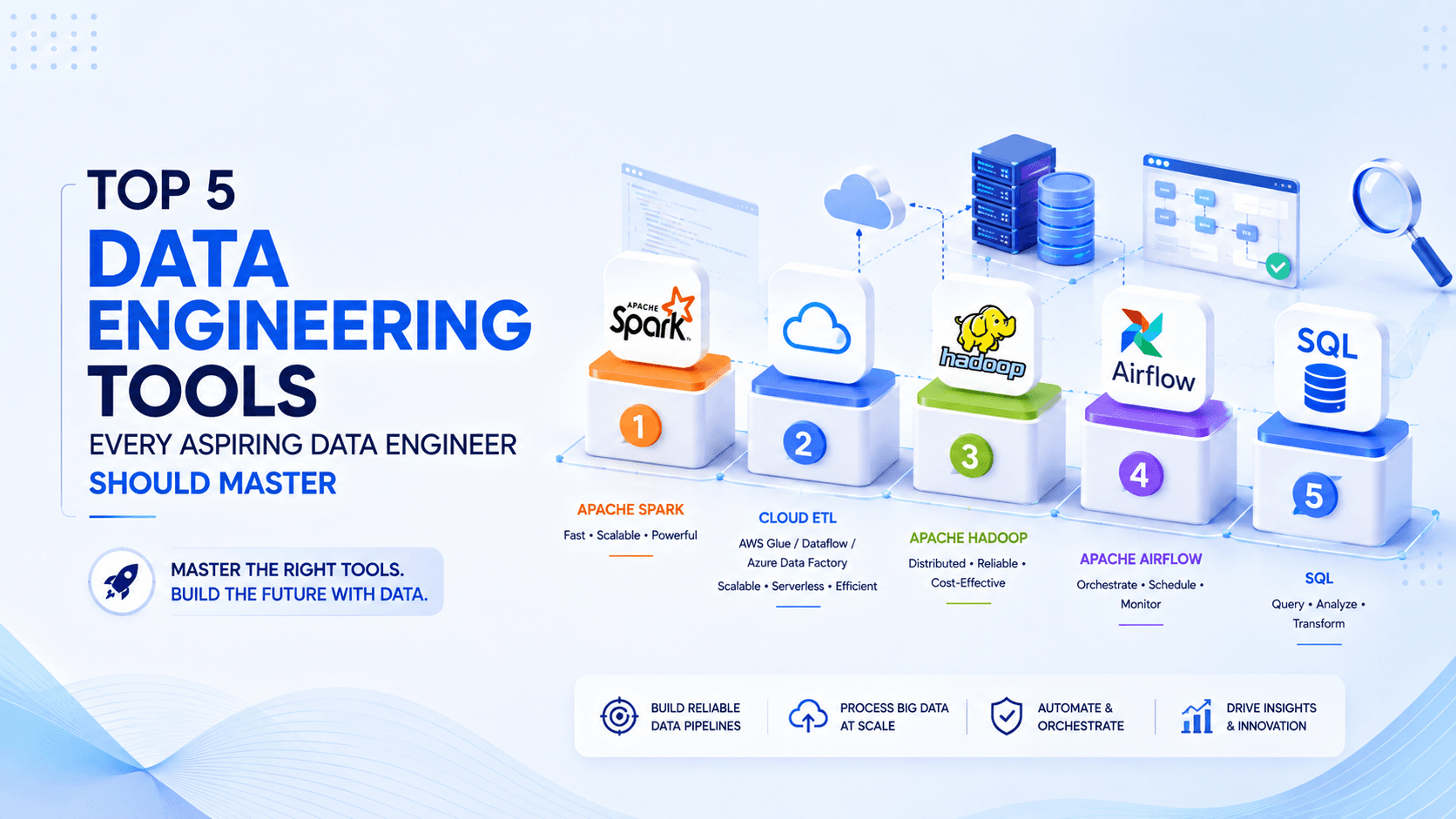
To construct resilient, scalable, high-throughput data pipelines capable of handling terabytes of enterprise telemetry, every Data Engineer in 2026 must develop hands-on mastery over **5 foundational tools**. This deep-dive architectural guide explores each tool in detail.
1. Apache Spark (PySpark) – Distributed In-Memory Processing
Apache Spark is the industry gold standard for distributed, in-memory big data computation. When dataset sizes exceed single-machine RAM limits, Spark splits data across worker nodes in a cloud cluster, executing parallel transformations at lightning speed.
Why PySpark is Essential:
- In-Memory Speed: Up to 100x faster than traditional Hadoop MapReduce by caching intermediate computations in worker RAM.
- Unified Ecosystem: Handles batch processing, Spark SQL queries, streaming telemetry, and GraphX processing in a single engine.
- PySpark API: Allows Python developers to leverage Spark's distributed cluster performance using familiar DataFrame syntax.
from pyspark.sql import SparkSession
from pyspark.sql.functions import col, sum as _sum, avg

# Initialize PySpark Session
spark = SparkSession.builder.appName("JVMSparkDemo").getOrCreate()

# Load 50GB Sales CSV File from Cloud Storage
sales_df = spark.read.csv("s3a://jvm-data-lake/sales/*.csv", header=True, inferSchema=True)

# Perform Parallel Group By Aggregation
summary_df = sales_df.filter(col("status") == "COMPLETED")     .groupby("region", "category")     .agg(_sum("amount").alias("total_revenue"), avg("discount").alias("avg_discount"))

summary_df.show(10)
2. Serverless Cloud ETL (AWS Glue, Azure ADF, GCP Dataflow)
Managing physical ETL servers is inefficient and costly. Serverless cloud ETL services allow Data Engineers to run automated data ingestion jobs on-demand without provisioning or managing underlying virtual servers.
- AWS Glue: Fully managed serverless ETL service that automatically discovers schemas via Glue Crawlers and executes PySpark jobs on demand.
- Azure Data Factory (ADF): Visual data integration service for orchestrating complex hybrid cloud data copy and transformation pipelines.
- GCP Dataflow: Unified stream and batch data processing service powered by Apache Beam.
3. Apache Airflow – Workflow Orchestration as Code
In enterprise systems, data pipelines consist of dozens of interconnected tasks that must execute in precise order (e.g., Extract -> Transform -> Validate Quality -> Load Warehouse -> Trigger Dashboard Refresh).
Apache Airflow allows data engineers to author, schedule, and monitor complex Directed Acyclic Graphs (DAGs) using native Python code.
4. Apache Kafka – Event-Driven Real-Time Streaming
For modern applications requiring sub-second data processing (e.g., stock trading feeds, fraud alerts, ride-hailing location updates), Apache Kafka provides high-throughput, fault-tolerant publish/subscribe event streaming.
5. Advanced SQL & Cloud Warehouses (Snowflake & BigQuery)
SQL remains the universal query engine powering modern decoupled cloud warehouses. Platforms like Snowflake, Google BigQuery, and Amazon Redshift allow instant scaling of compute resources independently of data storage.
6. Architectural Blueprint: How All 5 Tools Work Together
1. Ingestion: Apache Kafka captures real-time clickstream events from web servers.
2. Processing: Apache Spark (via PySpark) reads stream batches, cleans null fields, and performs aggregation.
3. Orchestration: Apache Airflow schedules nightly batch syncs and monitors pipeline execution SLAs.
4. Storage: AWS Glue moves clean output tables into Snowflake cloud data warehouses.
5. Analytics: Business Data Analysts query clean Snowflake schemas using Advanced SQL to power executive dashboards.
Frequently Asked Questions (FAQs)
1. Which tool should a beginner learn first?
Start with Advanced SQL and Python. Once you understand database queries and basic coding, proceed directly to PySpark and Apache Airflow.
2. Does JVM Institute teach all these 5 tools hands-on?
Yes! JVM Institute Pune's Data Engineering program provides live hands-on projects using PySpark on Databricks clusters, Snowflake warehouses, Apache Airflow DAGs, and AWS Glue cloud jobs.
Master These 5 Tools at JVM Institute
Gain practical experience building production ETL pipelines with PySpark, Snowflake, Airflow, and AWS Glue in our 6-month Pune track.

JVM Technical Team
Published by senior IT faculty members and industry lead architects at JVM Institute Pune. Dedicated to empowering students with real-world Data Engineering, AI/ML, PySpark, and Cloud computing expertise.