Quick Section Index
- 1.What Are Artificial Intelligence and Machine Learning?
- 2.Why Choose a Career in AI and Machine Learning?
- 3.Step-by-Step Guide to Starting Your AI and ML Career
- 4.Essential Skills for AI and ML Freshers
- 5.Career Opportunities After Learning AI and ML
- 6.How Long Does It Take to Learn AI and ML?
- 7.Should You Join an AI and Machine Learning Course After Graduation?
- 8.Frequently Asked Questions
- 9.Ready to Begin Your AI and ML Journey?
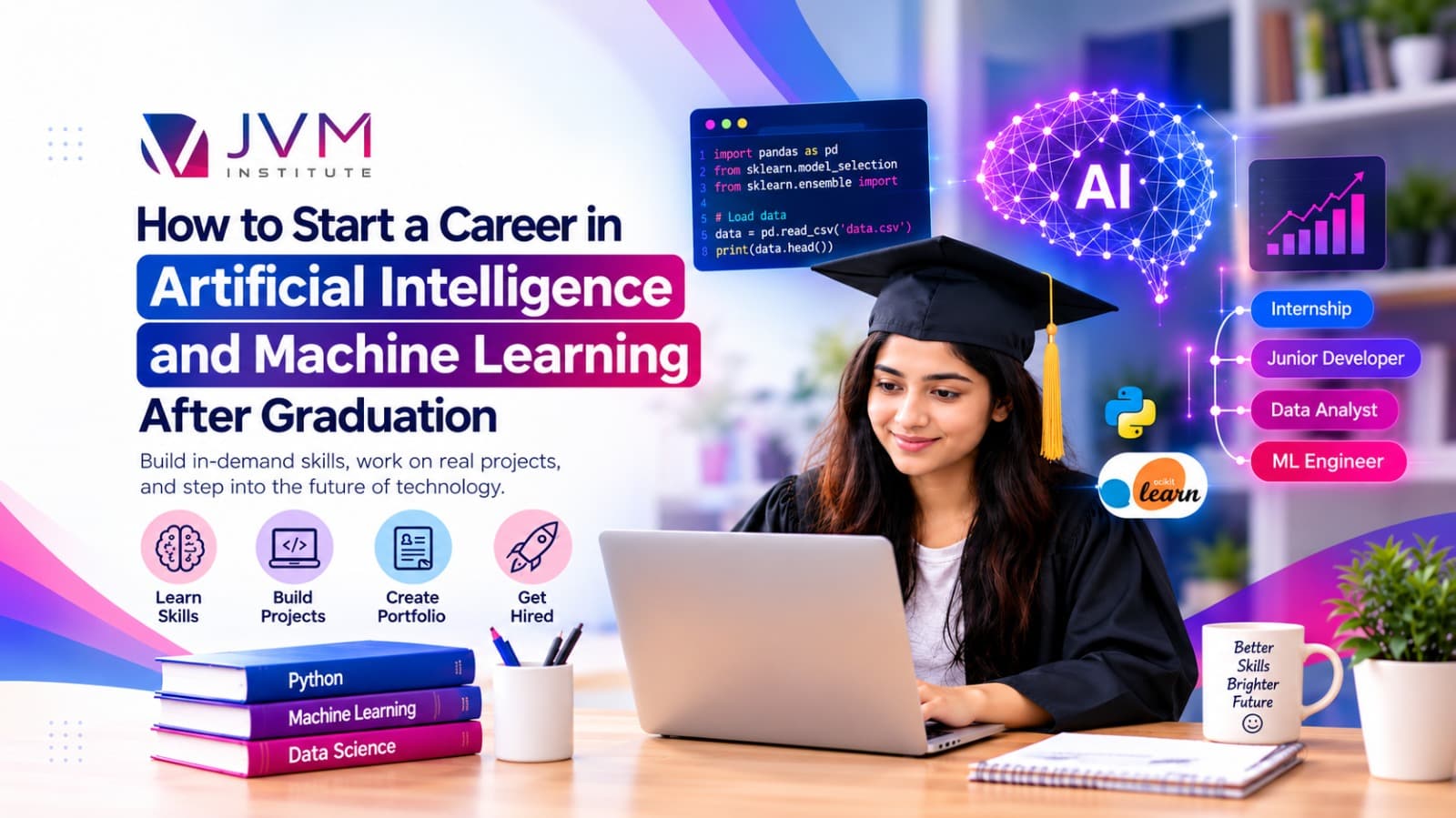
How to Start a Career in Artificial Intelligence and Machine Learning After Graduation
Build industry-relevant skills, create practical projects, and take your first step toward a career in AI and ML.
Have you recently graduated and want to build a career in one of the most exciting areas of technology? Artificial Intelligence (AI) and Machine Learning (ML) offer opportunities to solve real-world problems, automate tasks, analyze data, and develop intelligent applications.
Whether you have completed a degree in Computer Science, Information Technology, Engineering, Mathematics, Statistics, or another discipline, you can begin exploring AI and ML by developing the right technical skills and gaining practical experience.
This guide explains how to get started, which skills to learn, what projects to build, and how to prepare for entry-level opportunities in the AI industry.
What Are Artificial Intelligence and Machine Learning?
Artificial Intelligence is a field of technology focused on creating systems that perform tasks associated with human intelligence, such as understanding language, recognizing images, generating content, and supporting decisions.
Machine Learning is a branch of AI that enables computers to learn patterns from data and make predictions or decisions without requiring every rule to be explicitly programmed.
Examples of AI and ML applications include:
- Chatbots and AI-powered virtual assistants
- Fraud detection in banking and financial services
- Product recommendations in e-commerce
- Medical image analysis and decision-support tools
- Predictive maintenance in manufacturing
- Generative AI tools for text, images, and code
Why Choose a Career in AI and Machine Learning?
Organizations across industries are exploring AI to improve productivity, understand customers, automate repetitive work, and make better use of data. This creates opportunities for people who can develop, evaluate, and responsibly implement AI solutions.
Step-by-Step Guide to Starting Your AI and ML Career
Step 1: Understand the Fundamentals of Programming
Begin with Python, one of the most widely used programming languages in AI and data science. Learn variables, loops, functions, data structures, file handling, and object-oriented programming basics.
Practice solving small coding problems before moving to data analysis and machine learning libraries.
Step 2: Learn Mathematics and Statistics
Mathematics helps you understand how machine learning algorithms work. Focus on basic linear algebra, probability, statistics, and essential calculus concepts.
You do not need to master every advanced mathematical topic at the beginning. Build your understanding gradually as you study different algorithms.
Step 3: Develop Data Analysis Skills
AI models depend on data, so learn how to collect, clean, organize, and analyze datasets. Start with Python libraries such as NumPy, Pandas, and Matplotlib.
You can also explore SQL to retrieve information from databases and practice identifying patterns through charts, reports, and exploratory data analysis.
Step 4: Study Machine Learning Algorithms
Once you understand Python and basic statistics, begin learning supervised and unsupervised machine learning.
- Linear and logistic regression
- Decision trees and random forests
- Classification and clustering
- Model evaluation and performance metrics
- Data preprocessing and feature engineering
Use libraries such as Scikit-learn to train models, test their performance, and understand their limitations.
Step 5: Explore Deep Learning and Generative AI
After learning machine learning fundamentals, explore neural networks and deep learning. Depending on your interests, you can study computer vision, natural language processing, large language models, and generative AI applications.
Frameworks such as PyTorch and TensorFlow can help you experiment with deep learning. Learn how to use AI APIs and evaluate AI-generated outputs responsibly.
Step 6: Build Real-World Projects
Practical projects help demonstrate what you can do with your knowledge. Start with manageable projects and gradually move toward more complex applications.
- Student performance prediction: Analyze data to estimate academic outcomes.
- Customer churn prediction: Identify patterns associated with customers leaving a service.
- Spam message classifier: Build a model that classifies messages as spam or legitimate.
- Sales forecasting: Explore historical data to estimate future sales.
- AI-powered document assistant: Create a basic application that answers questions about supplied documents.
Document your approach, dataset, code, evaluation results, and limitations. Publish suitable projects on GitHub so recruiters can review your work.
Step 7: Create a Strong Resume and Portfolio
Your resume should highlight relevant technical skills, academic projects, internships, certifications, and measurable project outcomes where available.
Include links to your GitHub repositories and project demonstrations. Be prepared to explain why you selected a particular algorithm, how you handled data, and how you evaluated the results.
Step 8: Apply for Entry-Level Opportunities
Search for roles that match your current skills and experience. Suitable starting points may include internships, trainee positions, junior data roles, and entry-level AI or ML positions.
Prepare for coding exercises, Python and SQL questions, basic statistics, machine learning concepts, and discussions about your projects. Networking and participating in technical communities can also help you discover opportunities.
Essential Skills for AI and ML Freshers
- Programming: Python and basic software development practices.
- Mathematics: Statistics, probability, and linear algebra fundamentals.
- Data handling: SQL, Pandas, NumPy, and data visualization.
- Machine learning: Algorithms, model evaluation, and feature engineering.
- AI tools: Familiarity with relevant frameworks, APIs, and development environments.
- Problem-solving: Analytical thinking, debugging, and experimentation.
- Communication: Explaining technical work clearly and working with a team.
Career Opportunities After Learning AI and ML
Your first role will depend on your educational background, skills, project experience, and employer requirements. Consider exploring these career paths:
- Data Analyst: Analyze datasets and communicate business insights.
- Junior Machine Learning Engineer: Help develop, test, and maintain machine learning models.
- AI Developer: Build applications that use AI models and services.
- Junior Data Scientist: Apply statistics and machine learning to investigate data-driven problems.
- NLP or Computer Vision Trainee: Work on language-processing or image-analysis applications.
- Generative AI Application Developer: Develop applications using large language models and related tools.
Some roles require substantial experience or advanced qualifications. Review job descriptions carefully and choose positions that align with your current level.
How Long Does It Take to Learn AI and ML?
Your learning timeline depends on your existing programming knowledge, study schedule, and the depth of skills you want to develop. A beginner might use the following roadmap as a starting point:
- Months 1–2: Python, programming fundamentals, and basic mathematics.
- Months 3–4: Data analysis, SQL, statistics, and data visualization.
- Months 5–6: Machine learning algorithms and beginner projects.
- Months 7–8: Portfolio development, interview preparation, and job applications.
This is an illustrative plan, not a guarantee of job readiness. Learners with programming experience may progress faster, while others may need additional time to practice and strengthen their fundamentals.
Should You Join an AI and Machine Learning Course After Graduation?
A structured course can help you follow a learning path, practice with guidance, and receive feedback on your projects. Before enrolling, compare the curriculum, trainer experience, hands-on assignments, mentoring, and career support.
Look for a program that covers Python, data analysis, machine learning, practical projects, and relevant advanced topics. Ask whether you will build portfolio-ready projects and receive support with resume preparation and mock interviews.
Choose a course based on your learning goals and available time. Continue practicing independently so you can apply what you learn to unfamiliar problems.
Frequently Asked Questions
Can I learn AI and ML after graduation without an IT background?
Yes. You can start by learning Python, mathematics, and data analysis. Your progress will depend on consistent practice and your willingness to build the required technical foundation.
Is Python necessary for a career in AI?
Python is one of the most useful languages for AI and machine learning because of its libraries and ecosystem. Other languages may be relevant for particular roles, but Python is a practical starting point for most beginners.
Do I need a master's degree to enter AI and ML?
Not for every role. Some entry-level development and application-focused positions accept candidates with a bachelor's degree and relevant skills. Research-focused or specialized positions may prefer postgraduate qualifications.
What should an AI and ML fresher include in a portfolio?
Start with two or three well-documented projects that demonstrate data preparation, model development, evaluation, and clear communication of results. Include readable code and explain the limitations of each project.
Can freshers apply for AI and ML jobs?
Yes. Look for internships, graduate trainee programs, junior roles, and AI application development opportunities. Employers vary in their requirements, so tailor your applications to each position.
Ready to Begin Your AI and ML Journey?
Start building your technical foundation, work on practical projects, and prepare for opportunities in Artificial Intelligence and Machine Learning.
Explore training options at JVM Institute and choose a learning path that matches your career goals.
Explore JVM InstituteDiscover how to start a career in Artificial Intelligence and Machine Learning after graduation. Explore essential skills, courses, projects, and career opportunities.
Explore technical architecture details and live engineering code examples.

JVM Technical Team
Published by senior IT faculty members and industry lead architects at JVM Institute Pune. Dedicated to empowering students with real-world Data Engineering, AI/ML, PySpark, and Cloud computing expertise.