Quick Section Index
- 1.Introduction: The Invisible Backbone of Modern Tech
- 2.What Does a Data Engineer Actually Do?
- 3.1. The Architectural Evolution of Enterprise Data Systems
- 4.2. Core Technical Competencies & Toolstack
- 5.3. Anatomy of a Production ETL Data Pipeline
- 6.4. Real-World Applications Across Industries
- 7.5. 2026 Salary Growth & Career Scope in India
- 8.Frequently Asked Questions (FAQs)
- 9.Start Your Data Engineering Journey Today
Introduction: The Invisible Backbone of Modern Tech
Every single day, over 328 million terabytes of raw digital data are generated across global networks. From mobile app clicks and credit card swipes to IoT sensor telemetry and cloud server logs, digital information floods enterprise systems at unprecedented velocity.
Yet without structured processing systems, 90% of enterprise data remains unstructured, isolated, and unusable. Data Engineers are the invisible backbone who construct the resilient digital highways that transform chaotic raw data streams into clean, reliable, sub-second business intelligence.
This comprehensive guide explores the complete journey of a Data Engineer—from understanding underlying system architectures to mastering big data frameworks, real-world industry applications, and building a high-paying career in 2026.
What Does a Data Engineer Actually Do?
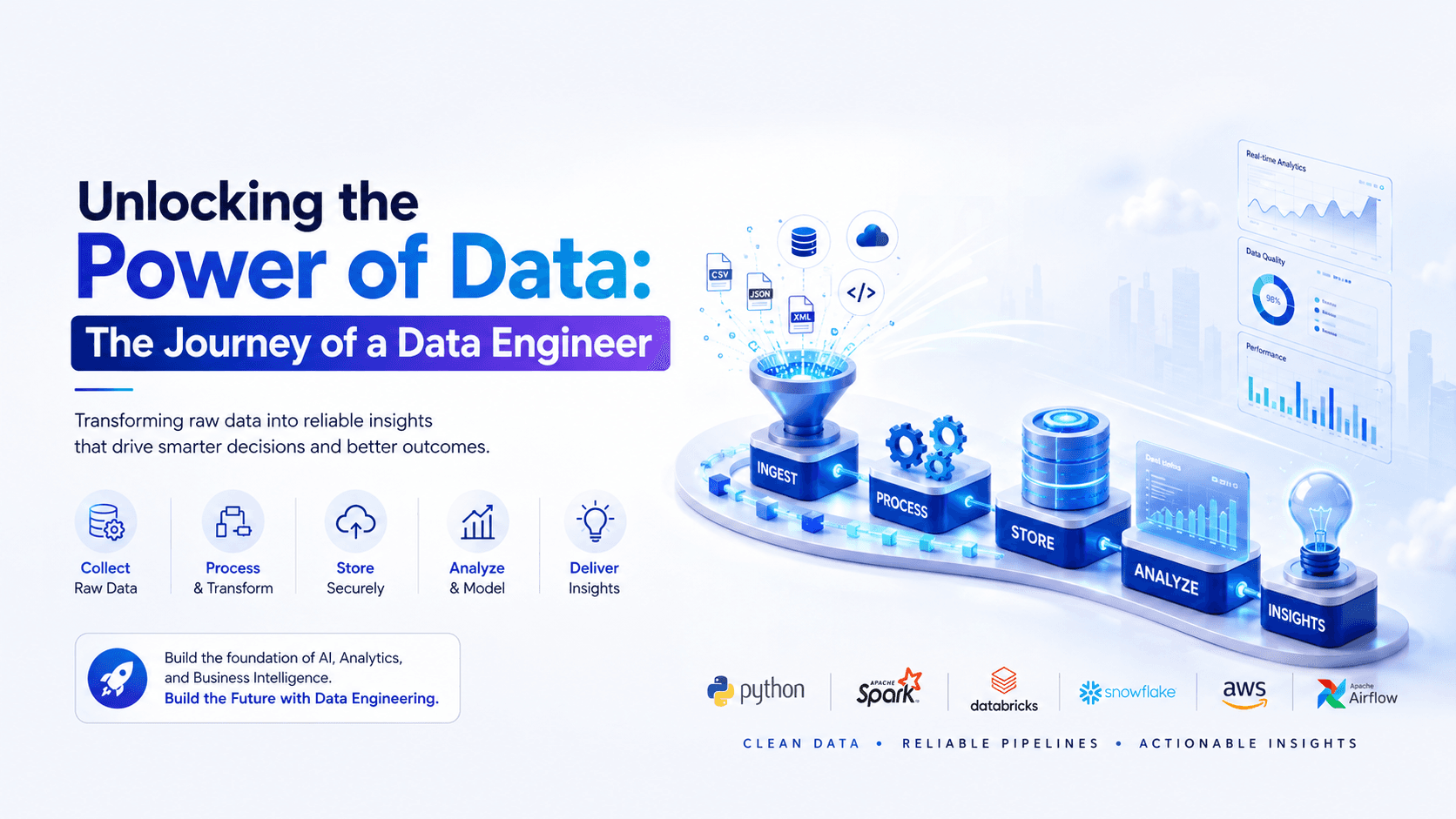
A Data Engineer designs, builds, and maintains the automated data pipelines, databases, warehouses, and storage architectures that feed business analytics dashboards and machine learning models.
While software engineers build user interfaces and web APIs, Data Engineers focus on the high-throughput flow of data behind the scenes. They ensure that data is ingestion-ready, formatted correctly, partitioned efficiently, encrypted securely, and delivered without latency.
1. The Architectural Evolution of Enterprise Data Systems
Data engineering has evolved through three monumental technological eras over the last two decades:
Era 1: Monolithic On-Premise Warehouses (2000–2010)
Relational databases (Oracle, Teradata, DB2) ran scheduled nightly batch SQL scripts on physical servers. Storage and compute were bound together, making scaling expensive and inflexible.
Era 2: Open-Source Big Data & Hadoop (2010–2018)
Apache Hadoop introduced distributed file storage (HDFS) and MapReduce. Companies could store petabytes of unstructured text and logs across commodity server nodes.
Era 3: Cloud Lakehouses & Real-Time Streaming (2018–2026)
Modern platforms decouple compute from storage. Tools like Databricks, Snowflake, Apache Spark, AWS Glue, and Apache Kafka enable serverless ETL, real-time event streaming, and unified Lakehouse analytics.
2. Core Technical Competencies & Toolstack
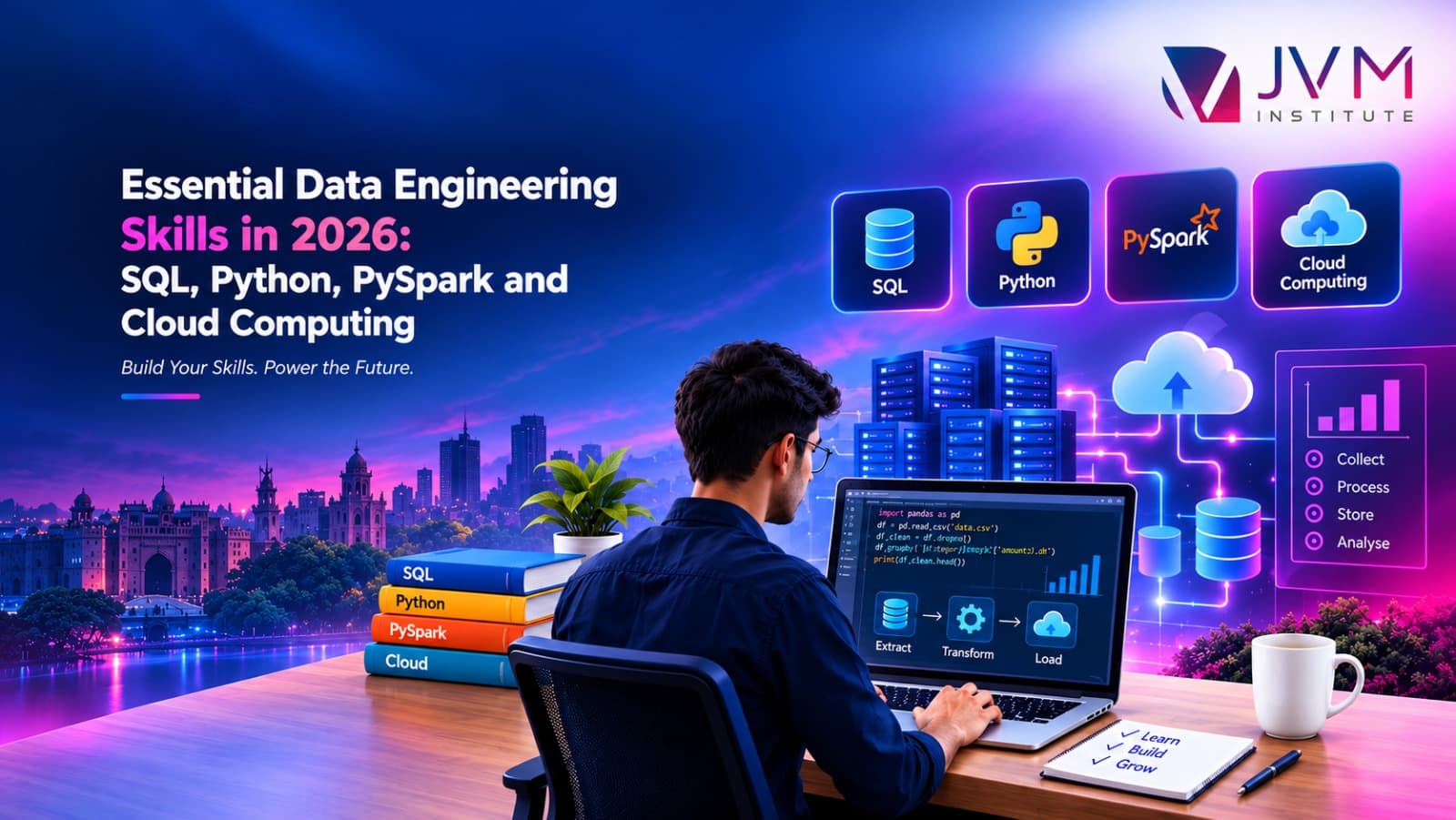
To excel as a Data Engineer in 2026, you must develop hands-on mastery over five technical pillars:
- Python & PySpark: Writing clean, modular data processing code and distributed dataframe transformations.
- Advanced SQL & Query Optimization: Mastering window functions, partition strategies, execution plan tuning, and schema design.
- Data Pipeline Orchestration: Building automated Directed Acyclic Graphs (DAGs) using Apache Airflow.
- Cloud Warehouses & Lakes: Designing schemas in Snowflake, Google BigQuery, Amazon Redshift, and AWS S3 object stores.
- Real-Time Streaming: Ingesting continuous message queues via Apache Kafka and Spark Structured Streaming.
3. Anatomy of a Production ETL Data Pipeline
In a commercial production setting, an ETL pipeline performs three distinct tasks seamlessly:
from pyspark.sql import SparkSession
from pyspark.sql.functions import col, when, current_timestamp

# Initialize Spark Session for Distributed Data Processing
spark = SparkSession.builder     .appName("JVMProductionPipeline")     .config("spark.sql.shuffle.partitions", "200")     .getOrCreate()

# 1. EXTRACT: Read raw JSON telemetry logs from S3 Bucket
raw_df = spark.read.json("s3a://jvm-raw-telemetry-lake/2026/events/*.json")

# 2. TRANSFORM: Clean missing records, parse timestamps & compute flags
clean_df = raw_df.filter(col("user_id").isNotNull())     .withColumn("is_premium", when(col("account_type") == "VIP", 1).otherwise(0))     .withColumn("processed_at", current_timestamp())

# 3. LOAD: Write transformed clean data into Delta Lake Warehouse
clean_df.write.format("delta")     .mode("append")     .partitionBy("event_date")     .save("s3a://jvm-clean-warehouse/telemetry_fact/")

print("Pipeline execution complete! Written clean partition data.")
4. Real-World Applications Across Industries
Fintech & Banking
Sub-second Kafka streaming pipelines analyze transaction velocity and IP geolocation to detect and block credit card fraud before approval.
Healthcare & Diagnostics
Automated cloud pipelines ingest patient monitor telemetry and genomic sequences, rendering clean datasets for diagnostic AI models.
5. 2026 Salary Growth & Career Scope in India
Data Engineering is widely recognized as one of the fastest-growing technology careers in India, offering high job stability and top-tier compensation:
- Fresher (0–1 Yrs): ₹4.8 LPA – ₹8.5 LPA
- Mid-Level (2–5 Yrs): ₹9.0 LPA – ₹22.0 LPA
- Senior Engineer (5–9 Yrs): ₹22.0 LPA – ₹38.0 LPA+
- Lead / Cloud Data Architect (10+ Yrs): ₹38.0 LPA – ₹65.0 LPA+
Frequently Asked Questions (FAQs)
1. Can a beginner start learning Data Engineering directly?
Yes! Anyone with basic computer literacy can learn Data Engineering by following a structured learning path: Python syntax -> SQL queries -> Database concepts -> PySpark -> Cloud Data Warehousing.
2. How does JVM Institute help in landing a Data Engineer job?
JVM Institute Pune provides a 24-week classroom & online Data Engineering Master Track complete with live PySpark Databricks labs, AWS cloud projects, resume preparation, mock interviews, and 100% placement support.
Start Your Data Engineering Journey Today
Transform your tech career with JVM Institute Pune's industry-aligned Data Engineering track. Learn directly from experienced lead data architects.

JVM Technical Team
Published by senior IT faculty members and industry lead architects at JVM Institute Pune. Dedicated to empowering students with real-world Data Engineering, AI/ML, PySpark, and Cloud computing expertise.